
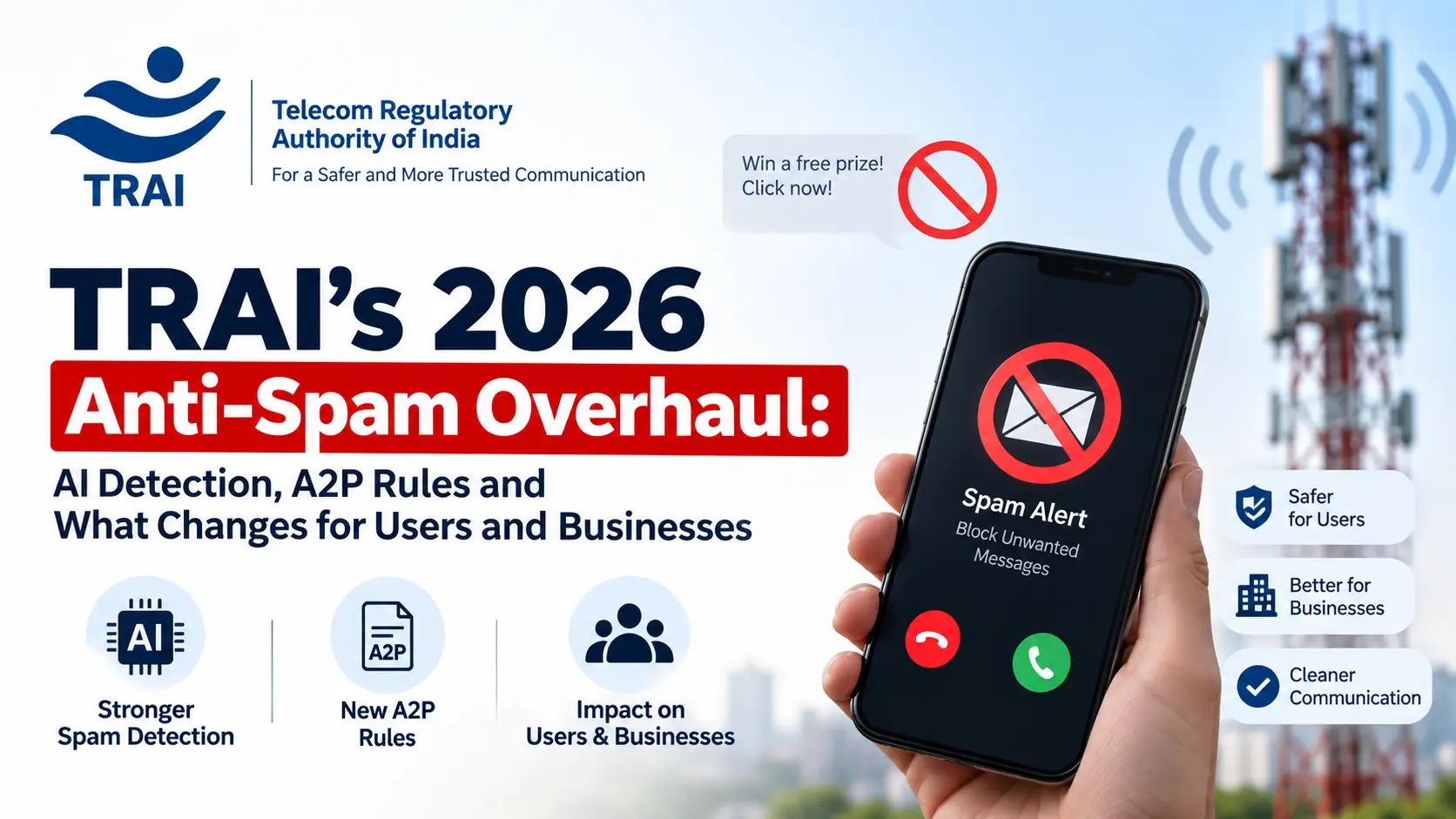
The Telecom Regulatory Authority of India (TRAI) has rolled out stricter norms to curb spam and unwanted commercial calls, bringing AI-driven detection, clearer rules for automated (A2P/robocalls) and a new consumer appeal mechanism into force from September 18, 2026.
What’s New in TRAI’s Anti-Spam Framework (September 2026)?
TRAI’s Telecom Commercial Communications Customer Preference (Third Amendment) Regulations, 2026 tighten enforcement against Unsolicited Commercial Communications (UCC) while adding safeguards so genuine business and government calls aren’t wrongly blocked.
1) AI/ML-Based Spam Detection Now Mandatory
- Telecom service providers (TSPs) must use AI/ML systems to identify Calling Line Identifications (CLIs/numbers) with a high probability of being used for spam and share this intelligence with other operators.
- If five or more numbers linked to the same sender are flagged within 10 days, access providers can initiate graded action: KYC re-verification, physical verification, barring outgoing services, and, for repeat violations, disconnection of telecom resources.
- Regulated commercial numbering series (140xx, 1600xx, 1601xx) will not be flagged as suspected spam for recipients, reducing false positives for legitimate campaigns.
2) Automated Calls (A2P, Robocalls) Brought Under Clear Rules
TRAI now explicitly defines Application-to-Person (A2P) calls as those initiated by an application, software system or automated platform without a human directly dialling—covering autodialled calls, robocalls, pre-recorded messages, and calls using artificial or recorded voices.
Compliance requirements for entities using A2P:
- Pre-declare the use of A2P systems to your telecom provider and provide the numbers (CLIs) you will use.
- Undeclared A2P calls will be treated as unsolicited commercial communication (UCC) and attract enforcement.
3) Termination Charge for Certain A2P Calls
- A termination charge of up to 5 paise per minute is introduced for A2P calls.
- Exemptions: A2P calls made via TRAI-designated numbering series for regulated commercial communications, and calls specifically authorised by TRAI, are exempt from this charge.
4) Consumer Appeal Mechanism Added
- Consumers now have an appeal route against certain actions taken under the anti-spam framework, with a 15-day window to escalate via existing channels (TRAI DND app, TSP platforms, 1909).
5) Restrictions on Call-Management Apps (Truecaller-style apps)
- Call Management Applications (CMAs) cannot blanket-block, filter or label as spam calls from designated series 140xx, 1600xx, 1601xx.
- CMAs must forward UCC reports submitted through their platforms to the DLT platform maintained by access providers; they cannot offer “spam/junk” reporting unless it routes to that platform.
- Individual users can still block or filter specific numbers on their own devices.
Why TRAI Made These Changes
The amendments aim to:
- Improve detection speed and accuracy using AI/ML, especially as spam patterns evolve.
- Prevent misuse of commercial headers/templates and ensure faster suspension (within six hours) of misused templates.
- Balance consumer protection with the need to keep legitimate business and government communications reachable.
What This Means for Businesses and Telemarketers
- Register on DLT, pre-approve headers and templates, and ensure all campaigns originate from the correct series (promotional via 140xx, service/transactional via 1600xx/1601xx as applicable).
- If you use A2P/voice AI agents, declare the service and CLIs to your TSP in advance to avoid UCC classification and penalties.
- Monitor complaint thresholds and CLI health; repeated violations can lead to one-year disconnection and blacklisting for telemarketers.
Concluding Note
TRAI’s 2026 update is a decisive step toward smarter, faster spam control—using AI to catch bad actors while protecting legitimate business and government outreach. For brands, the message is clear: declare your A2P systems, respect numbering series and keep templates clean. For users, the framework promises fewer nuisance calls and a clearer path to redressal when things go wrong.
Read Also – Google Gemini Notebook Gets Major AI Upgrade: Voice Chat, Lecture Recording & New Study Tools
